In this publication we will talk about that in contact with the road cars, about tires.
New tires.
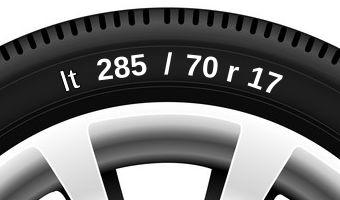
When it comes to the longevity of automotive parts, tires are certainly those accessories that need to be frequently checked. And all because of their condition affects the consumption of gasoline, governance and security. You do not have hard to find information about them, because, in accordance with the requirements of her put down right on his side! But you do not Locate – is how much the tire will live, but to predict the life of tires is not easy enough.
Factors affecting the life of tires
In the movie, everything seems to be too cool – the smoke from the wheels, drifting and screeching in a strong inhibition …. But it is quite cool activities doom your tires on early wear. Even if you do not control the machine as a chase scene from Hollywood movies, some unusual driving can destroy your tires. On appearance of your car tires can be judged on the style of your driving on your roads and even on the state of other parts and systems for cars. The following shows the facts that affect the lifespan of tires:
External temperature
The pressure inside the tire
Rotational speed
The proper location of the tires on one axle (the new front of the new, old vs. old)
Proper load on the car
Condition of the tires
One officer from the National Highway Traffic Safety Administration has shared some know-how “longevity” of tires:
Maintain proper tire pressure
Avoid overloading buses (do not load more weight than recommended by the manufacturer)
Avoid the dangerous road sections
Check your tires for the presence of cuts, strains and scratches
Although suppliers and auto makers have identified ways to test various components for durability, tires still remain something of an unknown. But all of the following factors: whether the driver kept the bus for a long time before using it in an inflated state (it is premature wear on it) Has the bus to high temperatures, and so on.
In the 70 years of the last century Tyre had a different life, they lacked the twenty-thousand miles (32,187 km), today this is definitely different figures – eighty thousand miles (128,748 km). Of course, mileage may be different, depending on the driver. Save money and protect the tires.
The content and maintenance
Would you like advice as to save a few hundred rubles to the U.S. automobile expenses? All too simple – keep the tires at the correct pressure. It is believed that properly inflated tire can lead to 3,3 -% fuel savings. Able to estimate how much you will save your bucks on each fill up. Tire pressure gauges are fairly inexpensive, it is easy to use and can be purchased at any auto parts store.
Cars manufactured in the United States after the September, 2007, have built-in pressure control in tires. But how do we know right now whether the pressure in the tires? If you’ve ever looked at your car, you probably paid attention to the informational stickers pasted on the details of the car. The legislation requires that this information was the most prominent places that would Motorists or technical staff can learn about the technical requirements for the repair and replacement of various parts.
Such information exists on the tires. Labels are usually in the glove compartment, fuel tank hatch or the front door jamb, as well as all information can be found in the attached to the machine instructions (handbook holder). Quality tires can fly into a pretty penny, but it is worth to spend money because they last longer. Maintain the correct tire pressure – very simple. For American cars maximum tire pressure stated in kPa and in pounds per square inch.
If the figures in the owner’s manual or on a label different from the real, is guided by information on the bus. Do not forget to monitor tire pressure when they are “cold”, ie before the trip. While driving air in the tire heats up, causing a pressure increase and expansion of the bus. Just need to inflate the tire to the desired level, and not to pump, otherwise unduly inflated tires can cause accidents.
Likewise, it would be nice to change the tire places every 5000 – 8000 miles (8,047 – 12,875 km). This will ensure even wear of tires, which in turn will prolong the life. If you know how to use a jack stand or a procedure is quite simple. But at some point a change of tires is not enough, you’ll have to replace them.
Replacement tires
In appearance of some parts may not understand it time to throw them away. But with regular monitoring of tires you will notice when worn tread, and therefore time to change the tire. To make sure that your tire tread is still in good condition, you can do the following experiment: Take a coin and draw an edge to deepen the tread back and forth. If the bezel (1,59 mm) is visible, the tread is worn. And of course, if you noticed on the cover flaws (such as deep cracks or bubbles), you should contact your tires or tire.
Tires are usually changed by two or four, because different cravings can lead to poor management. To ensure the safety and best comfort, it is necessary that all tires were the same size, same speed index, and were either radial or diagonal. The exceptions are some sports cars that have more than one-axle bus (the width and diameter) than the other. Even on a front wheel drive car when replacing two tires, both go to the rear axle.
Deep tread design helps maintain control on wet roads. Experts do not recommend changing only one bus. But if this is dictated by necessity, the new tire should be placed on the same axle with the tire, which has minimal tread wear. To detail have served longer needed timely monitoring and repair. Prolongation of life details, and buses, including – this is a simple method to save money and avoid premature wear.
Image via Wikipedia
Liked it
Email
RSS
Twitter


October 03, 2010
Could you please have an english speaking person edit the articles on this site?
I would be more than happy to correct the spelling, syntax and grammar for a small fee.
October 03, 2010
Good question: how long does it take to build a car?