
How to use tire calculator?
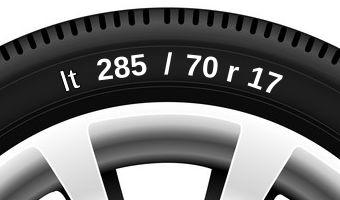
Our free online calculator helps you easily convert tire height, width, diameter, circumference in inches, and revolutions per mile for any tire. To get started, you need to know your tire code. Usually, the tire code is molded in the sidewall of the tire. Learn how to find and read your tire code here.
Once you know your tire code, do the following:
- select optional tire type: none, LT, P, ST, or T
- choose the tire width (in mm)
- choose the aspect ratio value
- pick construction type: R (radial) is the most popular one
- and finally, choose your wheel diameter (in inches)
- click on the refresh button to see all tire sizes in inches
Below the calculator, you will find a conversion table, and on the right — a tire conversion chart.
How do you calculate tire sizes?
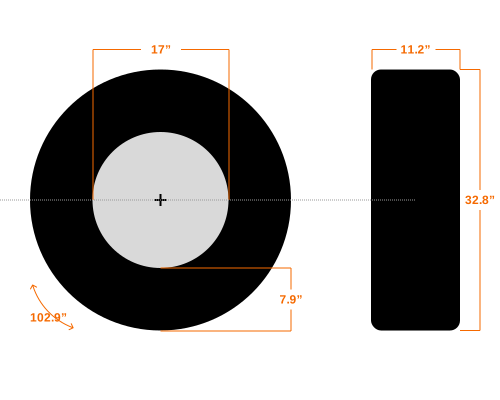
We use an inch to mm conversion formula and other basic mathematical formulas in our calculator. Let's break them down based on this tire size example:
Width
The first digits (285) in the code are the tire width in millimeters. To convert mm to inches, simply divide the number by 25.4:
285 mm ÷ 25.4 = 11.2″
Sidewall height
The next digits after the "/" sign are the aspect ratio (70). It shows the proportion of a tire width to the sidewall. We know the tire width in inches and the ratio, so we can calculate the sidewall height this way:
(11.2″ × 70) ÷ 100 = 7.9″
Overall height or tire diameter
This is the easiest part. The tire height is a sum of a wheel diameter and the two times of a sidewall height. The wheel diameter is the last digits in the tire code after the "R" letter, and it's already in inches: 17.
17″ + 7.9″ × 2 = 32.8″
Circumference
Time to remember your elementary school! Circumference is calculated as π × diameter:
3.14 × 32.8″ = 103″
Revolutions per mile
There are 63,360 inches in a mile, so to get a revolutions number, divide this number by the circumference:
63360 ÷ 103 = 615